|
The Care and Feeding of, "They Love a Can of Green Worms" Paramount (or is that universal) to using any piece of equipment effectively, is having some understanding of what is going on inside. This is especially true for the Oscilloscope. |
|
|
||
|
|
|
|
 |
|
- 2) And, the Horizontal Scanning or Sweep Circuits, that "spread out" and synchronize the display of events on the CRT. - Also, there are very important subsections that interface these two main sections. The ability to cause the beam to start at some event is crucial: to this end, the vertical input amplifier furnishes an amplified version of the input signal voltage to a "sync detector" which tells the horizontal sweep generator to sweep, or spread out the signal, when the signal transitions through some preset voltage or trigger level preset by the user. In other words: "when the little green wiggly worm raises his little green head above or below some pretend crayon mark on the screen, he's kicked in his little worm butt, and flies across the picture, leaving an `uuie-gooie' green slime trail." - As important to knowing what is going on inside, is knowing how to make effective measurements using an integral part of the oscilloscope: the Scope Probes. The probe and how it is used, can make or break the usefulness of the oscilloscope. To skimp on the quality of the probe, is like buying a big expensive television set for a couple thousand dollars, and then connecting it to fifteen dollar rabbit-ears. - TOP Probe Inputs, "Channel A, B, " A Probing
Question
|
||||
|
||||
| A
"Check-List" for Measurement is as Follows:
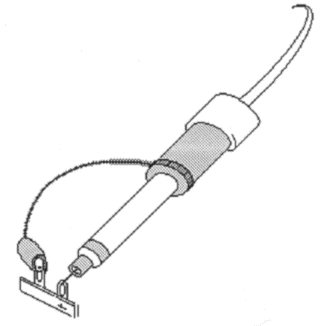
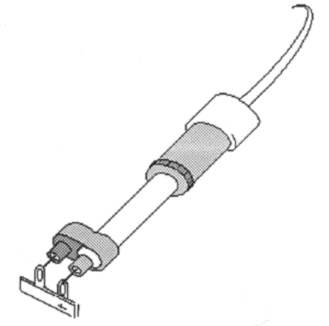
1.. Always use "X 10" probes: they load the DUT (device-under-test) ~ 10 Meg ohms @ ~ 10 pfd. A "X 1" probe offers 1 Meg ohm @ ~ 50 pfd. The designation "X 10" refers to the attenuation of the signal by the probe (not gain). In order to attain such light loading by the scope--while maintaining bandwidth--this tradeoff is required. 2.. Make sure the probes are compensated (adjust trimmer at connector housing) if attaching them to a different scope. This ensures maximum fidelity and bandwidth of the signals being eyeballed. 3.. Use the shortest ground lead or clip-lead possible: the shorter the better! Excessive ground lead length introduces unnecessary inductance and can alter the displayed signal, as well as reducing the scope's effective bandwidth (acts like a lowpass filter). 4.. When Measuring very high frequencies--especially in tight spaces--consider using a RF probe (see figure). Also, there are--so-called--FET or active probes, which are non-loading (almost) wideband probes with built-in amplifiers. 5.. When buying probes for your oscilloscope, make sure the probe is of sufficient bandwidth for your particular scope: the probe is the first-order bandwidth determinant of any scope. Some scopes have such a wide bandwidth, that no passive probe is able to do it justice, and the only way to use the maximum bandwidth of this type of scope is to drive the scope from a 50 ohm source through a 50 ohm coax, terminated into 50 ohms at the scope's input. In fact, some high performance scopes have a 1Meg ohm/50 ohm termination switch for just such occasions. Channel
A, Alternate, Chop, A-B, Channel B
A Delay in Discussing a Loose End Something
that cheap scopes are guilty of, is the fact that you never see the leading
edge of the event that triggered the sweep. That is to say, the sweep is
triggered by the leading edge of a pulse, and by the time the beam starts
across the screen it is now displaying the signal ~ 100 nsec after the
event. To solve this little "hand-is-quicker-than-the-eye" problem, the
Keebler
Elves added wideband analog delay lines between the vertical amplifier
and the CRT's deflection plates. So, by the time the beam has started its
short trip across Mr. CRT's face, the signal that triggered the sweep is
finally dribbling out of that long delay line.
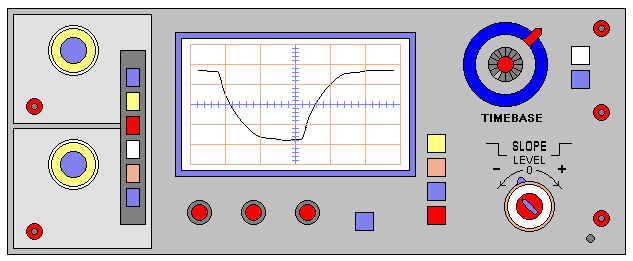
On the Level Oscilloscopes have several sync modes: internal sync; external sync; line sync and delayed sync. The selection of any of these sync sources sends the signal to the "sync detector." For example: if the internal sync is selected, it sends the input signal, picked-off from the vertical input amplifier, to the "sync detector" which is a fast analog comparator that gets its other comparison input from a front panel mounted control, called the "LEVEL" control. This allows the user to preset the exact voltage level and polarity, at which the scope "triggers" the sweep generator to sweep the beam across the screen once. Every time the signal goes above this preset voltage (except during an active sweep time), a new sweep is started: this is called "Triggered Sweep." Oh, By The Way... There is a sweep begun when ever the signal reaches the trigger level, regardless of whether it is a rising or falling voltage. This means that--in the case of a sine wave--the scope is just as apt to start the display at zero degree phase, as 180 degree phase. To solve this little oversight, a switch is used to tell the sweep generator which excursion--rising or falling--to trigger on: this is called the "SLOPE." (+) SLOPE (-) The figures show several combinations of settings.
|
||||
|
|
||||
|
"Delayed Sweep." Another feature of most good scopes is "Delayed Sweep." Delayed Sweep, allows the user (that could be you, if you behave and eat your vegetables) to trigger on an event and observe the signal after some predetermined time interval. For example: if you wanted to observe one single scan line--out of 525--in a television signal, you would trigger off the beginning of each television field time (16.67 msec) but holdoff displaying that particular scan line (HD = 63.5 usec) until the correct amount of time has passed. In essence the Delayed Sweep is just a fancy "One-Shot" multivibrator with a ten-turn pot, triggered from the scope's normal sweep circuit; and holds off the sweep across the screen until some time interval--determined by our old friends Ms. R & Mr. C--has passed, after which time the scope sweeps for the interval of one TV scan line. Numbers Don't Lie... People Do: Let's say I wanted to eyeball the 188th horizontal scan line, and I had dialled in both the "Delay" and the "Sweep" intervals: as soon as the field sync pulse (VD) occurs the delay sweep starts to time out for 11,885 usec (187 x 63.5), at which point it triggers the scope's sweep generator. The sweep runs for ~ 65 usec--displaying one complete horizontal scan line (the 188th). Other
features of the oscilloscope that are available, are left for the user
to discover in the user's manual: you know, that thing you read when "all-else-fails!"
|
 |
|
|
Web Author: Glen A. Williamson Suggestions are Solicited, Please |